


Thoracic Rotation Assessment and Correction
- Chris Larrauri

- Apr 8
- 4 min read
The thoracic spine is a key contributor to how the body functions. When it's not rotating in a manor sufficient enough for the surrounding joints to function with the motion necessary to complete a task, then the body will start to compensate and find range in places it may not want to. Our bodies are fantastic compensators. This leaks energy throughout the kinetic chain.
Let's relate this to a football QB. When you go to throw the ball if the upper back isn't extending or allowing hip shoulder seperation, then the arm will do most the work. This takes velo off the ball when you have to throw it on a line and puts more stress on the arm. Another example is a pitcher in baseball. If the t-spine is lacking extension and rotation the body compensates through the arm. With a pitch, the elbow already recieves forces unlike anything else in sport. We want to allow the rest of the body to do most of the work to protect the elbow as best as we can.
I'm not saying we can't perform tasks in sport at a high level while leaking energy, we aren't going to get on the subject of perfect movement, but we can help create strategies that can reduce injury risk and could* increase performance. At this stage in sports, we have an understanding of key contributors of various movements. The t-spine is one of them.
In today's blog I will provide a case study on how to access thoracic rotation, provided by the titliest performance institute, and things we are going to do to get the function of the area in a better position to allow other joints to move more freely.
Assessment
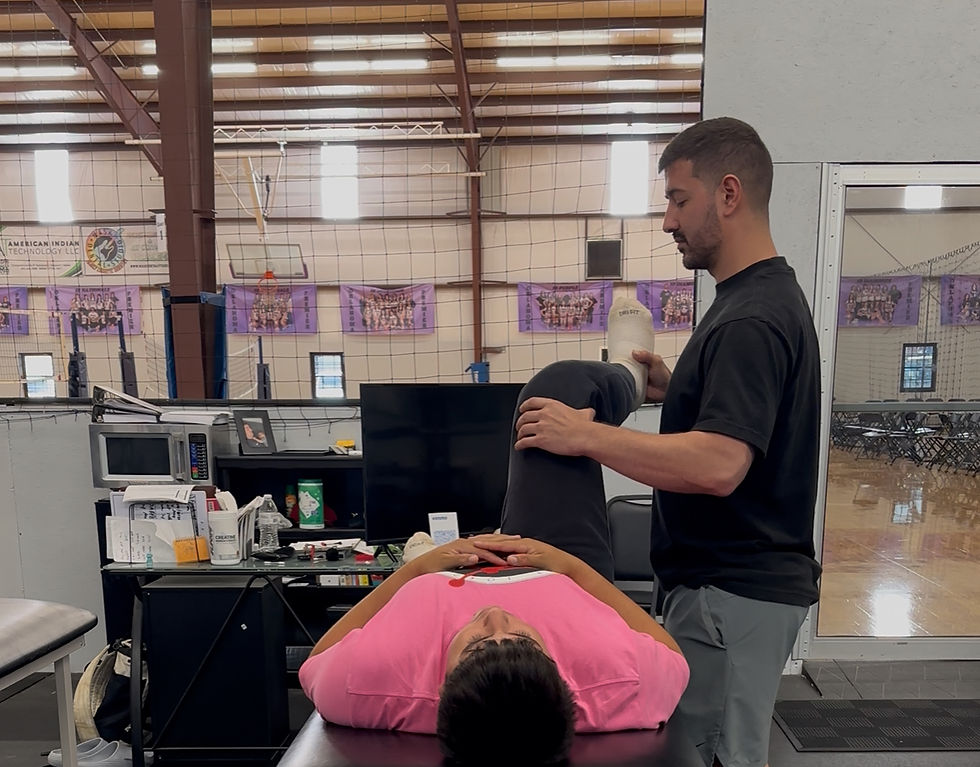
I didn't want to put all of my thoughts in the video so I could speak a little more here. If you notice, he initially gets about 45* of rotation which is a red flag. After I pulled him, it made him realize he had more motion and was able to get more range on his own. That got him to about 85* which is good.
If you notice, it's hard to tell in the video, but he is a little more kyphotic or rounded through his upper back. With the initial range he got, my thoughts were to increase extension through the upper back and that will create more range. When I pulled on him that created more extension allowing more rotation. With his initial posture eval he had rounded shoulders and rounded upper back. This led me to believe it's not rotation he's lacking, it's extension.
Now, if we look at various resting postures we see a few things. Here is an image of the main ones.

Zane is the middle one, not as prominent but the one that describes him the best. Here are a few things we did to help him with this.
My 5-Dimensional Warm-Up is as such

By starting here we can increase range where needed or decrease it while heating up the body and getting it prepared for other movements. With this in mind, It starts with soft tissue work. In this case the pecs, subscap, and the lats needed to be worked on to create transient, temporary, change to allow us to get a little deeper.
Next came specific stiffness. As stated previously he needed to loosen up the front side of the body while activating the back side. A great one I started with is below:
1. Medball T-Spine Extension
You could of also used something like
Gravity plays into the position you choose. That's why I went with the medball one.
Next we went to global stiffness. After we were direct with the T-Spine by itself, then I wanted to include more joints. That led me to the next two exercises below.
2. Stability Ball DB Pec Stretch
3. Deadhangs
A great regression to this if the athlete doesn't have the requisite strength to do the previous exercise is:
After this the pecs and lats are "stretched" out and the erectors on the back side are activated creating extension. Time to get more dynamic. There are a few options you could choose, here's what I chose.
4. Banded Quadreped Rock Back w/T-Spine Rotation
5. Foam Roller Half Kneeling T-Spine Rotation w/OH Windmill
After this his back is good to go and we can get into other exercises that create lasting change by strengthening the structures necessary to allow it. A couple off the bat would be:
Medball Half Kneeling Rotational Shotput
Cable Half Kneeling Row w/ Alternating reach
This allows for the region to be opened up, then trained at speed (or close), and finished off with the structures getting strengthened in those positions.
This was a case study, meaning it was a study of one. Every situation can be different but there are common things that we should start with. This is a common one that you will see more often then other cases.
Thank you for reading today's blog. Hopefully this provided value to you.



Comments