


Functional Stability Training: Core – A Review

I Just recently went back through some old content and came across Mike Reinold’s and Eric Cressey’s Functional Stability Training (FST) for the core. I remember when I first watched it 6 years ago, a lot of the “physio” world was new to me. I have worked alongside Athletic Trainers (AT’s) at previous places I worked but not directly with a Physical Therapist. FST really helped me understand posture better. In contrast it made me a much better coach coming from the strictly performance realm I was in. It ceases to amaze me how much we can learn from watching/rereading the same material twice. I am always looking to sharpen the tools in the toolbox and gain better perspective from some of the best. If you want to skip this review and go directly to the source here’s a link: » Functional Stability Training.
This is the first one in a series of four. I will be writing a review covering the lower body and upper body also, so be on the lookout. Anyway, enough with the promotions back to FST.
FST was split into two parts, Classroom and Lab. I won’t speak much about the lab portion. There is a bunch of great information covered during that part, so I recommend you check it out. I want to stick to the classroom portion and end with a lab of my own. I want to hit 3 main topics covering the course: what FST is, how it applies to the core, and some practical applications that coaches or/an athletes can use in various setting. We all know knowledge isn’t power, applied knowledge is. Give some of these “physio” things a chance. I implemented some of it and have been seeing big ROI.
Mike Reinold begins by speaking about what FST is. He touches upon how this approach pulls principles from multiple disciplines such as physical therapy, strength & conditioning, orthopedic surgery and several other areas of expertise. Right off the bat Mike touched upon a key point “Traditional programs miss a critical component of performance – STABILITY.”
Here is simplified version of my Physical Preparation Philosophy. Stability is Crucial for great function. Mike boyle has what I refer to as the stiffness/mobility chart (He calls it the stability/mobility chart) that helps us understand what needs to be stiffer and what needs to be mobile to have better stability of the body. Form follows function not the other way around. I’ll go ahead and throw in maximal strength (or maximal force) shouldn’t be built upon “disfunction” (whatever that word means) in the coaching space. All too often this occurs, and we have strength coaches, personal trainers, & sport coaches alike being puzzled by why they aren’t getting the results they are intending to get. I understand we have athletes that just aren’t responders but in my experience that’s much fewer than the ones that do respond. Progress is different for everyone but is produced non the less if all aspects of coaching are dialed in. We can get on the optimal train, but I digress. STABILITY IS IMPORTANT. So much so, that its the foundation that I build everything else upon.
Here is something in which I refer to as my performance skyscraper

FST follows 5 main components
Motor Control Re-education
Dynamic Stability
Isolated Strength
Reactive Neuromuscular Control
Endurance Training (Capacity)
These components work in tandem with manual therapy of some sort weather self-induced or by someone that is licensed to do so to restore posture, stiffness, mobility, coordination, strength etc. Essentially we want to produce the bottom layer of the skyscaper which I call “Function.” This is basically getting the body working right, then building capacity under those conditions.
The Issue between many physios, orthopedic surgeons, biomechanists, S&C coaches is how does the body function properly? Mike touches on a point of what is the true role of our muscles? We learn in anatomy that muscle contract in an eccentric, isometric, and concentric fashion. Depending on what muscle it is, the line of pull will dictate what movement occurs. Take the glutes for example, We learn that how the glute is setup it allows for external rotation and extension at our hip. What wasn’t discussed was that the glute has fibers that cause internal rotation at a certain degree of hip flexion. Origins and insertions matter, along with pinnation angles.
Another less known fact is that about 40% of people have an insertion point from there Lat on the scapula, affecting the function of it. Some have and insertion point from the lat on the more lateral aspect of the ilium also. The Trapezius, even though it is one muscle, because of the pinnation angle of it will act in different ways. The low trap for example is more about allowing the scapula to upwardly rotate while the upper trap allows for scapular elevation. Same muscle different functions. We can also add in that the low trap helps posteriorly tilt the scapula on the ribcage and the upper trap assists in upward rotation of the scap. We can go on and on, the body is a complex system. The different portions of the body don’t work separately but in unison. Muscles can be prime movers and stabilizers.
Since we are covering FST – Core we can use the core as an example, when doing a back squat the core is stiffened to create allowance for energy transfer. If we do something such as a barbell Russian lean now the core is bending and must stabilize in a completely different way. I like to look at stability on a continuum because of the above example. The body has to stabilize regardless of how mobile or stiff an area is.
Here's a version of Mike Boyle Stability/Mobility chart. Here's a link to a paper covering it: Joint by Joint Approach

Like I said previously Stability is context dependant. I changed the word stable to stiff. Some joints need to be stiffer to create stability and some need to be more mobile to create stability dependant on context. Hyper mobility is a topic for itself.
What do I mean by context dependant. Lets take bench for instance. To create stability through the body and maximize the movement you want to keep most of the body stiff while the shoulder is mobile. Here is a visual for that.

Then lets take running for example. We want to keep the spine, other then the lumbar spine, mobile. This allows the spinal engine to do what it is intended to do. We also want the hips, knees and foot more on the mobile side in the air. Then to stiffen right before contact with the ground. Heres a visual to depict whats happening in the air while running.

This led to the question, how are joints stabilized?
Joints are stabilized by both passive and active structures. The active structures being the muscles. they can act as static (no movement) or dynamic (movement) stabilizers. How does this work?
To start we have our skeletal system

Our Skeletal system allows for us to have structure. Without this our bodies wouldn’t be able to hold itself up from gravity.
Next, we have Ligaments and Capsules
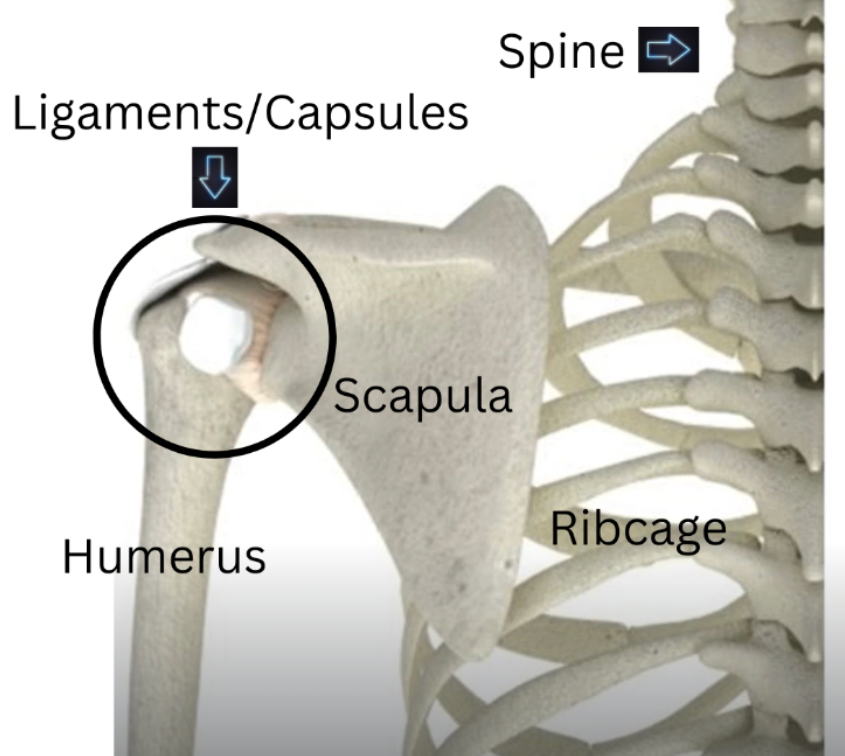
Although the Ligaments and Capsules allow for static stability, it is still a passive structure. Same with the skeletal system. Layered on top of the passive structures are the active structures (muscle, fascia etc.) that drive dynamic stability. If you want to argue that ligaments are active structures because it contracts we don’t exactly know that the capsule itself is contracting . Yes, it blends with fascia and muscle that contract but is the capsule actually pulling on those fibers or are those fiber pulling it? Take a band attached to a tow strap.

When we pull on the band attached to the strap the band extends and puts tension into the band. Newtons law says for every force there is an opposite and equal reaction force. The strap is creating force but is it actively making that like the band or passively? Just a thought going forward as we cover FST’s description of dynamic stability. If you want to say that the capsule stretches and adapts so its active, we can roughly say the same about bones, but we still consider them passive. Although bones don’t stretch to the degree a ligament does, when bone gets torsion, bending etc. applied enough times, itstarts to adapt. The ribcage bends and allows more motion but we don’t call it an active structure.
Anyways, in FST they describe dynamic stability as 4 things
Dynamic Ligament Tension
Joint Compression
Force Couples
Neuromuscular Control
We know that fascia blends with the muscle and the capsule. When the structures create tension, this causes what we know as dynamic ligament tension.
Joint Compression is from the cocontraction properties of the joint causing the bones to align how they need to for transmission of force in a manor, that stabilizes the joint.
Force couples are made-up of two separate kinds, you have the agonist force couple and you have the antagonist force couples. Agonist force couples are things such as the rotator cuff. You have multiple muscles working in unison to create a movement then you have things such as the antagonist force couples where it's the muscles working opposite of each other. For example, take your quad and hamstring. The quad does hip flexion as well as knee extension while the hamstring does hip extension as well as knee flexion. They work in opposites. I can get into Herring 's law and sherrington's law but that's for another day. We can also bring to the picture facial slings and how the muscle is conjoined with the fascia and various muscles work together in synergy to create force couples.
Last but certainly not least is neuromuscular control. this is how our muscle and our brain work together. This allows for proprioception which is the awareness of our body in space. It also allows for kinesthesia which is the bodies awareness of movement through space. Through efferent (output) and afferent (input) pathways communication is consistent between the brain and the muscles.


The main components that affect dynamic stability are muscular weakness, mental/ physical fatigue, imbalance, previous and current health status, and inflammation. So as a coach, physio etc. we need to be able to limit these influences and allow for an environment that reduces them.
I have covered a ton of information at this point. I will end the review here. This system has a ton of great information. Again, here is a link: » Functional Stability Training. I can’t recommend it enough. Be on the lookout for more in this series with regard to FST – Core and the other FST seminars and how it helped shape some of my thoughts over health and performance along with other systems such as, Triphasic, Conjugate, PRI, FRC, RPR and more that guided me to creating Function, Force, Form the horizontally integrated 5D Training Model to High Performance Trainng. See you for part 2 of the series.




Comments